The Mistakes US and EU RecOps Keep Making (and how you can avoid them)
This article was written in collaboration with
Jamie Jay Lyons, UK-based AI RecOps & Founder @ TheRecLab, and advisor First.cx
By now, we've all seen the trust between candidates and recruiters is diminishing. And when you take a closer look at the chaotic processes, misaligned tech stacks, and lack of accountability...you can understand why and how we've got to this point.
Amongst this chaos, without clear ownership, structure and strategy, you very quickly end up with over-engineered, performative processes, which soon leads to frustrated stakeholders, burnt-out hiring teams and angry candidates.
This is ultimately the problem that RecOps was birthed from.
RecOps is the natural progression when you stop thinking about recruitment as only a people problem, and start thinking about hiring as a system that can be monitored and improved, and more specifically, how that hiring system engages at the cross section of people, process and technology.
But the industry is changing very quickly, and two very different versions of RecOps have emerged, as a result of the local culture, regulation and economics. One of these cultures is in Europe, the other in the US.
Join us as we analyse the differences, lessons, and takeaways from each. Kicking off with the where it all started... The US.

The United States: 'Fast and Furious'
The US' calling card is build fast, fail fast: break it, then rebuild it through learning. This behaviour is so deeply ingrained in Silicon Valley's tech culture it's become synonymous with innovation itself, and a big reason so many of the world's breakthroughs have come from there. So much so that California alone would be the world's fourth largest economy!
But in a culture where the pursuit of individual glory drives quick experimentation, and an MVP-first instinct prizes speed over caution, that 'need for speed' often comes at the expense of safer, more ethical practices. US RecOps teams, especially those inside hyper-scaling tech companies, know this all too well: they're expected to keep pace with their product and engineering departments. So the same shortcuts often show up in hiring: tools shipped before they're tested for bias, candidate data moving faster than the policies meant to protect it.
This plays out clearly in how the US regulates hiring tech, or rather, how it doesn't. There's no federal regulation stopping a team from shipping a new tool like an auto-rejecting screener. No approval, no sign-off, no regulator at the door, just a patchwork of state rules. The check comes later, in court, once the damage is done. All of which creates an "it's only illegal if you get caught" mentality.
Yet some do get caught. In 2023 the EEOC settled its first AI hiring case: $365,000 from iTutorGroup, whose software discriminated against women aged 55 and up and men 60 and up. And the bigger one is still live: Mobley v. Workday, where the court is letting applicants sue the vendor itself, not just the employer, as a nationwide collective. Around 14,000 have reportedly opted in.
So you see, build fast, ship fast, worry later is the RecOps motto in the US. But if you cross the Atlantic to the EU, the story has unfolded quite differently...
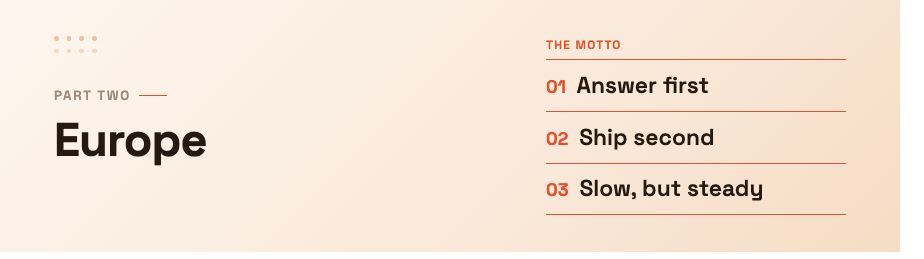
Europe: Slow But Steady
European RecOps teams have landed on the opposite end of the risk spectrum, because they've built inside one of the most demanding regulatory regimes, where how you hire is not just advised, but actively legislated, first by the EU, then by each country on top.
An early example of this is the introduction of GDPR in 2018: when control of personal data shifted to the individual, and Article 22 restricted letting a machine decide someone's fate with no human in the loop. Then the recent EU AI Act then cemented it all, flagging automation inside hiring as high-risk, with non-compliance running up to €15 million or 3% of global turnover.
So you see, while the US ships first and settles up in court later, in Europe both the vendor and recruiting team have to answer before anything ships at all, so naturally EU teams are a lot more cautious, and that regulation will only be tightening up in 2027.
But the differences go beyond regulation alone. Where the US is largely one market, European markets deal with fragmentation across multiple variables: by language, government, economy and culture across dozens of countries. Take Germany for example: you often can't even roll out a new hiring tool without the works council signing it off.
So when you combine all of this with tighter budgets than the US, you end up with multiple forces, all pushing the same way: slower, but steadier RecOps in the EU.

So What Can We Learn From Each Other?
As with anything, different strategies bring different trade-offs. In this case it's: speed against safety. Efficiency against fairness. Innovation against protection. Permission against forgiveness.
The trade-offs are very real and shouldn't be taken lightly. But if you take a step back and look underneath all of them, the US and Europe make the same mistake. They both react to whatever's in front of them instead of building the system intentionally. The US reacts to the tool market, a new tool for every gap. While Europe reacts to the regulator, a new process for every risk. One ends up with a bloated stack nobody asked for, the other a rigid process stuck in the past.
This is a challenge that RecOps leader Mariana "Maia" Miller has dealt with first-hand:
"It's especially hard to navigate when trying to move out of operating in a reactionary state, responding to the next tool, the next requisition, the next fire. The reactive pull can feel even stronger simply because of what's on your plate, which makes learning to prioritise intentionally a skill in itself. The real unlock, no matter if you are in the US, EU, or somewhere else, is finding the time to step back and design from a clear end goal: what does good actually look like for your organisation across every market you operate in? When you have that north star, the trade-offs become clearer and the decisions more intentional."
Intentional design beats reactivity: build the system on purpose, and make the tools and rules serve the system, not shape it. Architect it, instead of patching it. So what could that look like for each side in practice?
Europe steals the US bias to ship: move first but still play by the rules, investing in understanding the regulation fast as an advantage, instead of letting the caution harden into never.
The US steals Europe's discipline: design fairness in up front, treat candidates as people, and put the hard questions to your vendors before you buy, not to a courtroom after.
But the lines are already beginning to blur, and these two RecOps cultures are gradually merging...
Brexit muddies the water around future EU regulation.
US venture money is flowing into the UK and Europe, build-fast appetite and expectations attached.
The big AI labs are opening large UK and European offices, and their way of operating will become the local gold standard.
State AI hiring laws are spreading: NYC now mandates bias audits, with Colorado and Illinois passing their own.
And US companies hiring into the EU still have to answer to the EU AI Act.
And as these lines blur, they create an obvious temptation: see what's working on the other side of the Atlantic and copy it. But that's exactly where it goes wrong.
Because the worst RecOps trap of all is borrowing the behaviour without the conditions that made it work. RecOps rarely survives a copy-paste even between two companies in the same market. Lift it across an ocean, with all the extra variables, and it breaks far harder. You end up with speed and no safety net, caution with nothing to show for it, or just an outright mess. And people feel the difference.
As Nitin Moorjani puts it:
"You can tell when an Ops function is behind the engine. Candidates feel it. Hiring managers feel it. Recruiters feel it. The gap between a well-oiled TA function built on infrastructure and one that's winging it shows up in the hiring experience, every time. There's a real risk that the pace of change outweighs the investment going into RecOps, and left unmanaged, that leads to a fragmented hiring system not fit for purpose."
So before you rush to copy either side, sit with four questions about your own hiring setup:
People: can you explain how each part of your process genuinely serves the people moving through it, the candidate, the recruiter, and the hiring manager? Or is some of it there just because it always has been?
Process: can you trace why each step exists, and what breaks if you remove it? Or has the process grown by accretion, a new stage bolted on for every past problem?
Tech: can you explain the real trade-offs of every tool in your stack, what it costs as well as what it saves? If one of them started making mistakes tomorrow, would you know, and could you say why?
The real test: if any of the above got worse tomorrow, a candidate dropping out, a tool quietly rejecting the wrong people, a step slowing everything down, would you know? Would you have the numbers to catch it, or would it slip through the cracks?
If you can't answer these clearly, that isn't a US problem or a European problem, but it is a fundamental design flaw. And no tool or regulation fixes that one for you.
The best hiring machines, wherever they're built, have one thing in common: they're designed on purpose, around the people in them, the recruiter, the hiring team and the candidate.